Sunalite is reader-supported. As an Amazon Associate I earn from qualifying purchases. This post contains affiliate links. Learn more.
When the power goes out, the refrigerator is usually the first thing people worry about, and for good reason. A full fridge and freezer can easily hold a few hundred dollars of food, plus medications that need to stay cold. It’s also the most common reason people buy a portable power station in the first place.
So how long will a power station actually keep it running? The answer depends on your fridge, your power station and a few habits you control. Below we show you how to find your fridge’s real energy use, give you a simple run-time formula and table, and share the tricks that can double how long your battery lasts.

Table of Contents
Why Fridges Are Tricky to Estimate
A refrigerator doesn’t run constantly. Its compressor cycles on to cool things down, then shuts off until the temperature creeps back up. In a typical kitchen, the compressor runs somewhere around 30–50% of the time. So the wattage printed on the label (the running watts) overstates what it actually uses hour to hour.
What you really want is the fridge’s daily energy use in watt-hours (or kWh). Divide that by 24 and you get its true average draw. That average is what drains your battery.
Three things push that number up:
- Age: fridges from before about 2010 often use two to three times as much energy as current ENERGY STAR models.
- Style and features: side-by-side models, through-the-door ice and water, and built-in ice makers all add load.
- Room temperature: a fridge in a hot kitchen or garage works much harder in July than in a cool basement in March.
Find Your Fridge’s Real Energy Use
You have two good options:
- The EnergyGuide label. That yellow sticker lists estimated yearly energy use in kWh. Divide by 365 to get daily use. Example: 600 kWh per year ÷ 365 ≈ 1.64 kWh (1,640Wh) per day, or about 68W on average. If you no longer have the sticker, search your model number online.
- Measure it. Plug the fridge into a plug-in watt meter for 24–48 hours. It shows exactly how many kWh your fridge uses in your kitchen, at your thermostat setting. This is the most accurate method by far.
The Run-Time Formula
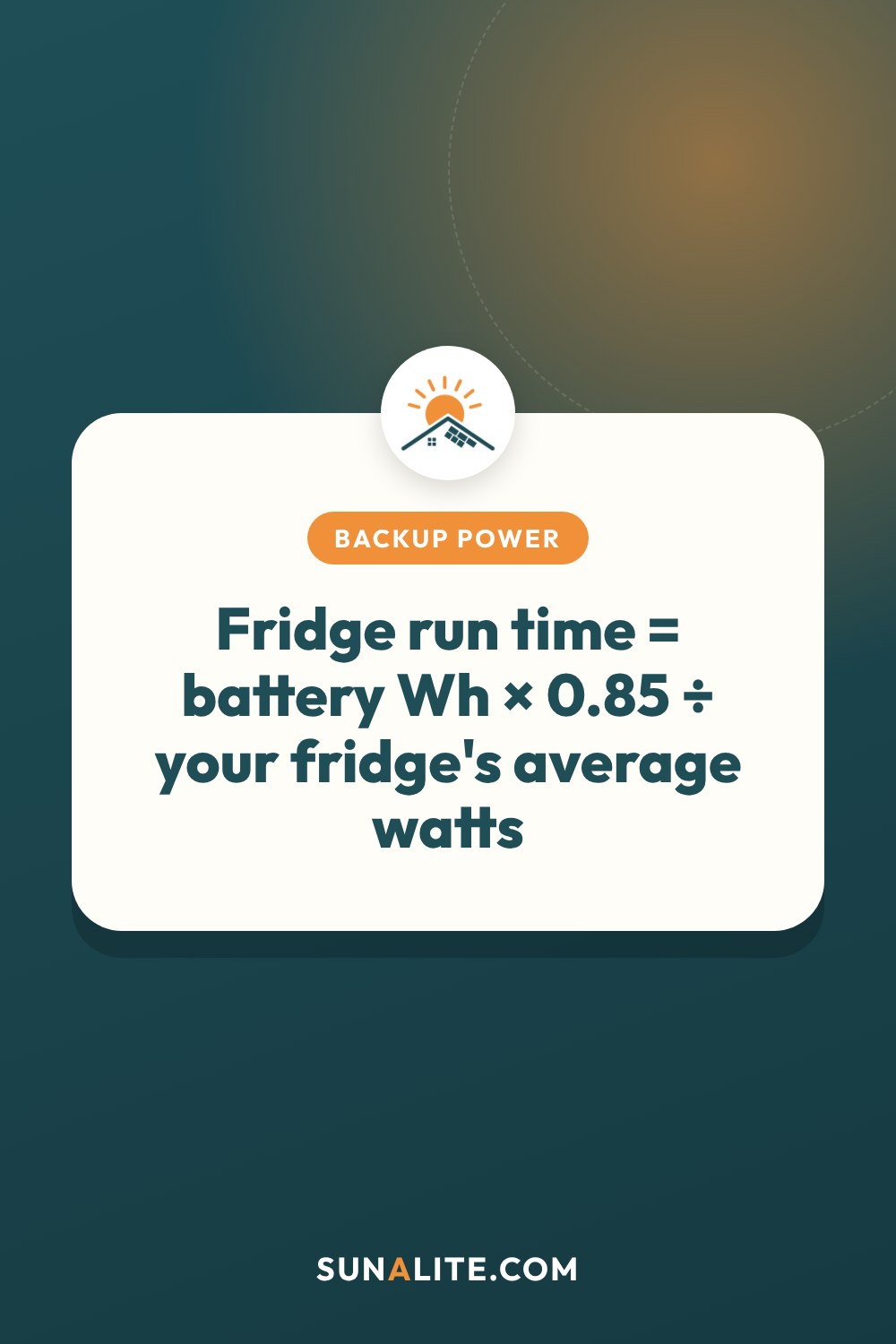
The 0.85 accounts for inverter losses. Converting battery power to household AC wastes roughly 10–15%.
Using the 1,640Wh-per-day fridge from the example above (about 68W on average):
| Power station size | Usable energy (×0.85) | Approximate fridge run time |
|---|---|---|
| 500Wh | ~425Wh | ~6 hours |
| 1,000Wh | ~850Wh | ~12–13 hours |
| 2,000Wh | ~1,700Wh | ~25 hours |
| 3,000Wh | ~2,550Wh | ~37 hours |
| 4,000Wh | ~3,400Wh | ~2 days |
Run Times for Different Fridge Types
Here’s how run times on a 1,000Wh station compare across common appliances. These are rough estimates based on typical energy use:
| Appliance | Typical daily use | Run time on 1,000Wh |
|---|---|---|
| Mini fridge | ~0.6–0.8 kWh | ~25–34 hours |
| Chest freezer (7 cu ft) | ~0.6–0.7 kWh | ~29–34 hours |
| Newer top-freezer fridge | ~1.0–1.3 kWh | ~16–20 hours |
| Newer French-door fridge | ~1.6–2.0 kWh | ~10–13 hours |
| Side-by-side with ice/water | ~1.8–2.3 kWh | ~9–11 hours |
| Older fridge (15+ years) | ~2.5–4.0 kWh | ~5–8 hours |
If you have a chest freezer in the basement, good news: they’re some of the most efficient appliances in the house and very easy to back up.
Don’t Forget the Startup Surge
When the compressor kicks on, it can pull 600–1,200W for a moment, several times its running wattage. If your power station can’t deliver that burst, it shuts off to protect itself. Any reputable 1,000Wh-class unit with 1,500W+ continuous output handles a typical fridge easily. Smaller 300–600W units may trip, especially with older fridges. If you’re between sizes, check our power station sizing guide.

How Long Is Food Safe Without Power?
Even with no backup at all, you have more time than you might think, as long as the doors stay closed. According to USDA food safety guidance:
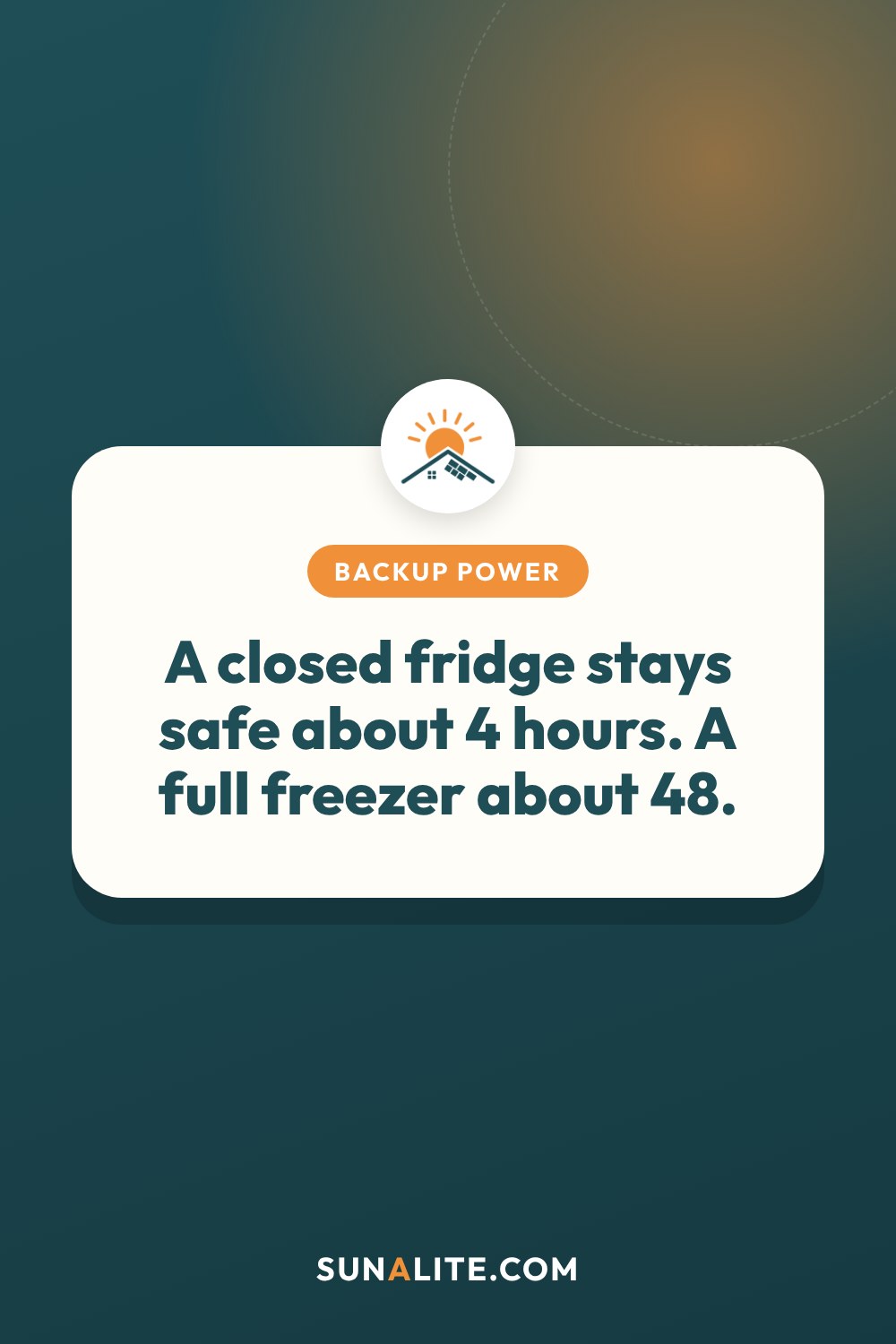
- A closed refrigerator keeps food safe for about 4 hours.
- A full freezer holds its temperature for about 48 hours (about 24 hours if it’s half full).
- Perishables that have been above 40°F for more than 2 hours should be thrown out.
That changes the backup strategy. You don’t need to run the fridge nonstop. You need to keep it cold enough, often enough.
7 Ways to Make Your Battery Last Longer
- Keep the doors shut. Every opening dumps cold air. Decide what you need before you open the door, and grab it fast.
- Run the fridge in cycles. Power the fridge for 1–2 hours to pull the temperature back down, then unplug it for 2–3 hours. Watch a thermometer. This can roughly double how long your battery lasts.
- Turn off the ice maker and any “quick freeze,” “door heater” or “energy saver off” settings.
- Fill empty space with jugs of water or ice packs. Thermal mass holds cold, so a full fridge cycles less often.
- Use a thermometer. An inexpensive fridge and freezer thermometer tells you exactly when to power back up. Keep the fridge at or below 40°F and the freezer at 0°F.
- Move the essentials. If the outage drags on, move milk, meds and leftovers into a good cooler with ice, and let the main fridge rest.
- Recharge with solar. A 200–400W panel can replace much of a fridge’s daily use on a sunny summer day. See our solar explainer.
Fridge and freezer thermometers
A pair of appliance thermometers tells you whether food is still safe and when to power the fridge back up. Leave them in year-round.
UPS Mode: The Set-It-and-Forget-It Setup
Many newer power stations offer UPS or pass-through mode. You plug the station into the wall, plug the fridge into the station, and leave it. When the power drops, the station switches to battery in about 10–30 milliseconds, fast enough that the fridge never notices. When power returns, it switches back and recharges.
It’s ideal for people who travel, work long shifts or simply don’t want to drag cords around during a storm. Two things to check: the manufacturer should explicitly support continuous pass-through use, and you’ll want an LFP battery that tolerates being kept at a high state of charge.
Best Power Stations for Fridge Backup
Look for LFP batteries, at least 1,500W of output for compressor surge, and UPS or pass-through mode:
EcoFlow DELTA 3 Plus
- 1,024Wh, 1,800W, handles compressor surge easily
- Add an extra battery for longer outages
- Fast switchover when the power drops
Jackery Explorer 2000 v2
- About 2kWh, runs a typical fridge for about a day
- 2,200W output for surge headroom
- Straightforward to use
Anker SOLIX C1000 Gen 2
- 1,024Wh with 2,000W output
- Very fast recharge between outages
- Strong value for the size
For more options, see our best power stations for home backup.

Frequently Asked Questions
Can a 500W power station run a refrigerator?
Sometimes, but it’s risky. Many fridges surge past 600W on startup, which can trip a 500W inverter. A 1,000Wh-class unit with 1,500W+ output is a much safer choice.
Can I run a fridge and freezer at the same time?
Yes, if the combined surge fits within your station’s peak rating. Compressors rarely start at the exact same moment. Capacity is the bigger constraint: two appliances drain a 1,000Wh unit in roughly half the time.
Is it OK to plug a fridge into an extension cord?
Use a short, heavy-duty cord (12 or 14 gauge) rated for the load if you need one to reach the station. Avoid thin household cords and power strips.
Should I keep the fridge on battery or let it warm up a bit?
Cycling is fine and saves a lot of energy. Keep the fridge at or below 40°F by checking a thermometer, and power it up when it approaches that line.
The Bottom Line
Look up your fridge’s yearly kWh, divide by 365, and compare that to about 85% of your battery’s capacity. For most households, a 1,000Wh station covers an overnight outage, and 2,000Wh or more covers a full day. Cycling the fridge and keeping the doors shut can stretch either one much further.